
A Dream is Born
William Tyndale (b. 1490-1494) was born just a few decades after the revolutionary printing press enabled mass production of books for the first time in history. The Gutenberg printing press had revolutionized the industry and made mass dissemination of ideas and information possible in a way that had never been possible before. The Protestant Reformation was, in part, a product of this revolutionary invention. While there had been pockets of those who had protested the abuses of the Roman Catholic Church before, they had been isolated and disconnected. But, the printing press made it easier to share ideas than ever before.
The Greek New Testament produced by Erasmus (1516) only confirmed what many scholars already suspected–the Latin Vulgate was not only in a language that was inaccessible to most people, but was also not the best translation of the original Greek and Hebrew. The Catholic Church’s insistence that the Bible and its interpretation be restricted to the clergy–many of whom were desperately corrupt–was now untenable for many, like Luther and Tyndale, who were committed to biblical authority.
Protestant Christians today take for granted the idea that all creeds and institutions are evaluated by the teachings of Scripture, but this doctrine of the Authority of Scripture was precisely the flashpoint between early Protestants and the Roman Catholic Church. The papacy had long taught that only the Church could rightly interpret Scripture, effectively placing the Roman clergy in authority over Scripture.
But for Luther, Tyndale, and many others, this idea ran counter to the plain teachings of Scripture itself. The problem, of course, was that most people could not read Scripture, because the only approved translation at the time was the Latin Vulgate–and most Englishmen didn’t speak Latin. For that matter, many clergy did not speak the language well and were themselves pitifully unknowledgeable about the Scriptures. During a dinner with such a clergyman, Tyndale frustratedly exclaimed, “If God spare my life, ere many years pass, I will cause a boy that driveth the plow shall know more of the Scripture than thou dost.”
“If God spare my life, ere many years pass, I will cause a boy that driveth the plow shall know more of the Scripture than thou dost.”
William Tyndale

Success and Opposition
Inspired by Luther’s zeal (and perhaps Luther’s Bible translation into German in 1522), Tyndale set out to produce his own English Bible translation in 1523. There had been an English translation by Wycliffe in the 1380’s, but it would not suffice anymore for several reasons. First, the Catholic Church had made a concerted effort to purge the land of the translation, so they were hard to find. Secondly, the English language had changed in the intervening century and a half. Wycliffe’s translation had been in what we now call “Middle English,” but Tyndale lived in a time marking the beginning of what we call “Modern English.” Lastly, Wycliffe’s translation had been from what was accessible to him at the time–the Latin Vulgate. With Erasmus’ recently published Greek New Testament, a new English translation from the original languages was now warranted.
But he would find no support for an English translation in England. While the Church had initially permitted Wycliffe’s translation efforts, they had reversed course after his death. In 1408, the Roman Catholic Church declared it illegal to translate the Bible into English. Finding no support in England for his translation, Tyndale journeyed to Hamburg, Germany and began working on his translation in 1524. But, as his translation work was being printed, a friend of his mistakenly shared too much about Tyndale’s work and word got around to leading Reformation opponents. Tyndale fled with the partially printed New Testament to Worms, a city that was much more sympathetic to the Reformation, and resumed working on the translation. In 1526, Tyndale completed and printed his new English Bible translation. He printed 6,000 copies and began smuggling them back into England.
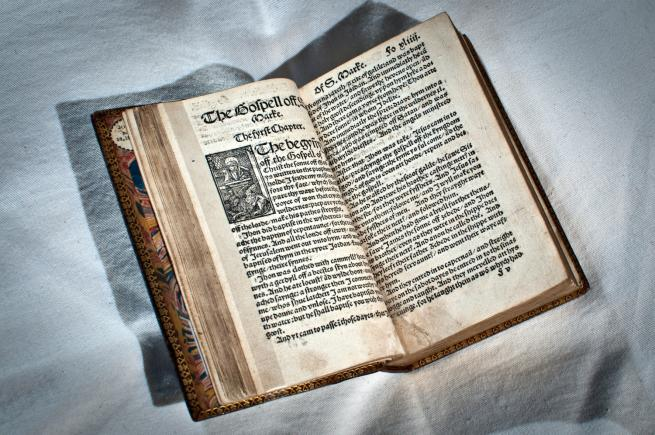
Predictably, the authorities were not pleased. The bishops in England, including bishop Tunstall, a former colleague of Tyndale’s, gathered up as many copies as they could find. There were public book burnings at St. Paul’s Cathedral of Tyndale’s translation. Only three copies of Tyndale’s 1526 New Testament have survived to the present day–one is located in the State Library of Württemberg, Germany; another is housed in the British Library, and the third is, ironically, housed at St. Paul’s Cathedral in London, the very site at which so many other copies were burned so many years ago. You can view a black and white copy of the 1526 Tyndale New Testament online, or purchase a full-color facsimile reprint by Hendrickson publishers from most online bookstores (though it is now out of print and more difficult to find). Tyndale House Publishers and Crossway have also partnered and are releasing a commemorative 500th Anniversary facsimile of the 1526 Tyndale New Testament around September 2026!
A Costly Book
One of Tyndale’s greatest opponents, William Warham, the archbishop of Canterbury, inadvertently became one of Tyndale’s best financial partners when, in an effort to eliminate all traces of Tyndale’s translation, he bought up as many copies as he could find. The funds from the sales ended up funding Tyndale’s further work of revising his translation and publishing more!
Tyndale continued his work, going on to translate the Pentateuch (the first five books of the Bible) in 1530, and making numerous revisions to his New Testament. He was in the process of translating the rest of the Old Testament when he was betrayed by a friend to the authorities in Antwerp, Belgium, where he was now living, and arrested in May 1535. Tyndale spent the next year and a half in prison before his execution in 1536. He was executed for his belief that Scripture ought to be accessible to the common man. Tyndale was strangled and then burned at the stake on October 6, 1536. His dying words were, “Lord, open the king of England’s eyes!”

The Legacy of Tyndale’s Translation
The authorities banned Tyndale’s translation, destroying every copy they could get their hands on. But, the legacy of his translation lived on. Tyndale’s translation would be later completed by a friend and colleague and published as the “Matthews Bible” in 1537. Just a few years later Tyndale’s prayer was answered–in 1539 the King of England authorized an English Bible translation: the “Great Bible.”
Tyndale’s translation was a translation for the common man. His verbiage was plain and natural for English speakers of his time, regardless of how it sounds to modern ears. Since Scripture was new to the English language, Tyndale had to coin many terms to translate Greek and Hebrew words into English. Some of the terms we use often in the church are owing to Tyndale’s translation: Passover, scapegoat, busybody, intercession, atonement, mercy seat, and more. Thus, with his Bible translation, Tyndale shaped not only the hearts of English speaking men and women, but their language, as well.
“I beseeche you therefore brethren by the mercifulness of God, that ye make youre bodyes a quicke sacrifise, holy and acceptable unto God which is youre resonable servynge off God. And fassion note youre selves lyke unto this worlde. But be ye chaunged [in youre shape] by the renuynge of youre wittes that ye may fele what thynge that good, that aceptable and perfaicte will of God is.”
Romans 12:1-2 (1526 Tyndale NT)
Tyndale’s translation would also influence every other major English translation to come for the next half a millennia. The King James Version, while itself a translation of the Greek and Hebrew, preserved as much as 90% of Tyndale’s wording, and since many subsequent English translations (i.e., the RSV, ESV, etc.) are to some extent revisions of the KJV, Tyndale’s legacy continues even into modern English translations 500 years later.
William Tyndale’s life was cut short, but he left a mark on English speaking people–and, by extension, the world–that far exceeded his brief years on earth. Every time you hear or see Scripture in your language and can clearly understand its plain meaning, Tyndale’s dream is realized. The “plowboys” of today—carpenters, plumbers, electricians, farmers, teachers, mechanics, and average “Joes”—can indeed know the Scriptures well, and many do thanks to Tyndale. As we celebrate 500 years since Tyndale’s New Testament, we celebrate the selfless sacrifice that Tyndale and so may others have made so that you and I could have a Bible in a language that speaks to our hearts. May we never take that precious gift for granted.
“And they overcame him by the bloude of the lambe & by the worde of their testimony & they loved not their lyves unto the death.”
Revelation 12:11 (1536 Tyndale NT)
