
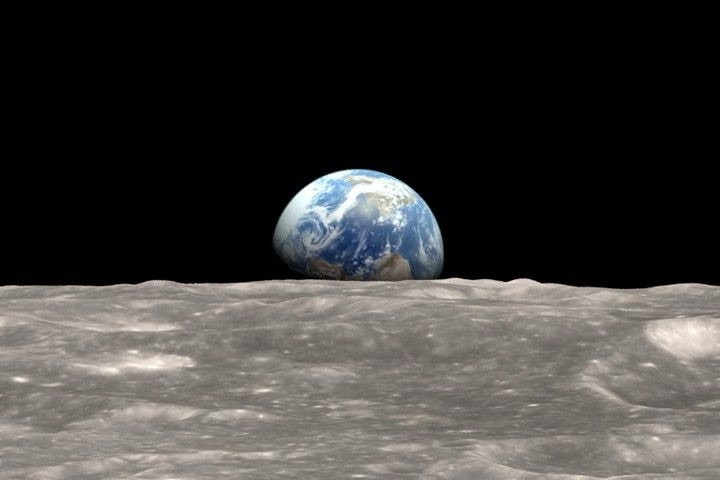
A few days ago, the Artemis II rocket launched with a mission to take astronauts to orbit the moon for the first time since the Apollo program ended in 1972–54 years ago. This launch is essentially a test launch to prepare the way for a future launch in 2028, in which NASA plans to land on the moon again and begin building a permanent lunar space station.

As I watched the launch, I couldn’t help but be mesmerized by the feats of engineering that this launch exhibited. This has been an incredible accomplishment. These astronauts will travel further from Earth than any humans ever have–over 250,000 miles away from the earth–and they will see portions of the dark side of the moon that humans have never seen. Just a few moments after the launch, the rocket had broken free of the Earth’s atmosphere into the great abyss of space. A few moments later, the rocket had reached a speed of over 17,000 mph and was already hundreds of miles from Earth. In its 10-day trip, it will cover over 685,000 miles as the astronauts orbit the earth and then go around the moon and back.

I sat and watched the stream in awe and amazement. It was emotional, even for me, as someone who really has very little connection to the event. There’s something about space travel that is just universally fascinating. People of all nations, ethnicities, and backgrounds can appreciate and marvel at it. It captures the imaginations of humanity in a way that few things do. And I think I know why.
Why are we so mesmerized by space travel?
For us as humans, the one thing that is usually constant for us is the ground. We’re bound to it. Gravity constantly pulls us and holds us to the earth. But, rockets and space travel seems to defy the limits of humanity and the laws of physics. In space travel, humans don’t just stand on earth and wonder what the moon and space are like—they can actually see it with their own eyes. They can defy gravity, transcend limitations, and see the earth from a perspective that only a handful of people in history have ever been able to do–a perspective that usually only God himself can enjoy. Here in a day or so, the astronauts will round the backside of the moon and—just as you and I might watch the sun rise—they will watch the earth rise over the horizon of the moon. It’s a bizarre and amazing thought that we can only imagine.
The rocket seems to defy the limits of humanity and the laws of physics—and yet, it doesn’t really. As amazing as a rocket launch is, it is still bound to the laws of physics and the limitations of humanity. In fact, they use these very laws of physics to propel themselves to space. It’s the law of gravity that allows them to slingshot around the moon and return back to earth, and these laws or physics and human limitations cause delays and cancellations of rocket launches all the time. The astronauts themselves have not, despite appearances, broken the laws of physics and nature. They’re still human. While in space, they have to eat, sleep, and use the bathroom. They’re incredible people, to be sure, but they’re still human. They’re still bound by the same limitations that you and I are. They still get sick, and they will still all, one day, die.
A real miracle
But something happened 2,000 years ago that truly DID defy the laws of nature and the limitations of humanity. As a handful of men and women mourned the death of a beloved friend, they gazed in wonder and awe as the Son rose. Death itself was broken and defeated. Something had transcended the very laws of nature and thrown off the limitations of humanity.

And so, just as days ago, the world watched in wonder as a rocket screamed into space, today, billions around the world are reminded that an even greater miracle than this has taken place. Jesus Christ has risen! And if he has risen, then the implications for you and I ought to leave us in wonder and awe and propel us into action as we reflect on what happened that day and what is coming for those of us who put our faith in him.
An Astronaut’s Perspective
During one of the Artemis crew’s interviews, Victor Glover—the first black astronaut to travel to the moon—said something very profound. The interviewer had asked something about what the crew thought of being in space on Easter, and listen to Glover’s reply:
Victor Glover (Artemis II Astronaut)
I think these observances are important and as we are so far from Earth and looking back at, you know, the beauty of creation, I think for me, one of the really important personal perspectives that I have up here is I can really see Earth as one thing.
And you know, when I read the Bible and I look at all of the amazing things that were done for us who were created, it’s — you have this amazing place, this spaceship. You guys are talking to us because we’re in a spaceship really far from Earth, but you’re on a spaceship called Earth that was created to give us a place to live in the universe, in the cosmos.
Maybe the distance we are from you makes you think what we’re doing is special. But we’re the same distance from you, and I’m trying to tell you, just trust me, you are special. In all of this emptiness, this is a whole bunch of nothing, this thing we call the universe. You have this oasis, this beautiful place that we get to exist — together.
Glover, referring to his biblical faith, described his view of Earth from space as an “oasis” in the midst of “nothingness.” From his perspective, it was clear that Earth was “created” for a purpose by a Creator. You could hear the wonder and awe in his voice as he tried to put words to what he was seeing from space.
What is so interesting about Glover’s unscripted, spontaneous reply is that it so closely matches that of the astronauts on the Apollo 8 mission that the interviewer had referred to. Astronauts on the Apollo 8 crew, as they orbited the moon on Christmas Eve 1968, described the moon as a “vast, lonely, forbidding-type existence or expanse of nothing.” Astronaut Lovell said that the Earth looked like a “grand oasis in the big vastness of space.”

While we watch in awe as astronauts orbit the Earth and moon, they look back in awe and wonder at the stunning beauty of creation and marvel at the power and goodness of the Creator.
A Heavenly Perspective
There’s something about the backdrop of stark black nothingness that really puts the oasis we call Earth into perspective. Sitting here on the Earth, it’s easy to take things such as oxygen, water, grass, and the sunrise for granted. Immersed in the Creation, it’s easy to assume it must always be like that.
But, an astronaut knows better. It didn’t have to be this way. An astronaut knows that if he takes on step outside of the safety net of his capsule and protective gear, he will perish. There is no oxygen, no grass, no warmth—only a hostile, black abyss that would suck the life from him instantly. An astronaut is constantly reminded that no other planet can provide the sustenance he requires for life. Against such a hostile backdrop, Earth takes on a newfound beauty. It is a refuge from the forces of the abyss that surround it. It sustains and gives life. Without it, we would perish.
So it is with Christ. The beauty of Christ and the glory of Easter cannot be fully comprehended unless one reflects with an astronaut’s eye view of what might have otherwise been. The beauty of Christ’s forgiveness cannot be fully comprehended and appreciated unless one views it on the black backdrop of our sin and rebellion. Christ is a refuge amidst hostile forces that would drain the life from us in an instant. Christ provides and sustains life—eternal life—in the midst of death. We need an astronaut’s perspective—a heavenly perspective.
Maintaining the Wonder
A famous British evangelist, Gypsy Smith, was once asked what his secret to ministry was. Gypsy famously replied, “I never lost the wonder of it all.”
I never lost the wonder of it all.
Gypsy Smith
Do you feel the wonder of what Christ has done for you? Are you mesmerized by the beauty of his mercy, grace, and provision against the backdrop of your sinful rebellion? Or are you, like so many of us who fail to appreciate the wonder of the creation with which we have been blessed, taking the blessing of salvation for granted?
At Easter, Christ provided salvation, justice, mercy, atonement, adoption, purpose, freedom, and eternal life. It did not have to be that way. He could have left us drifting in the abyss of our own sins. But, praise be to God, he did not.
May we never lose the wonder of it all!
Listen to the sermon:


One response to “The Wonder of it All”
Jason, You have a way of putting things in perspective that cuts through the clutter and brings it home to me. Thanks!